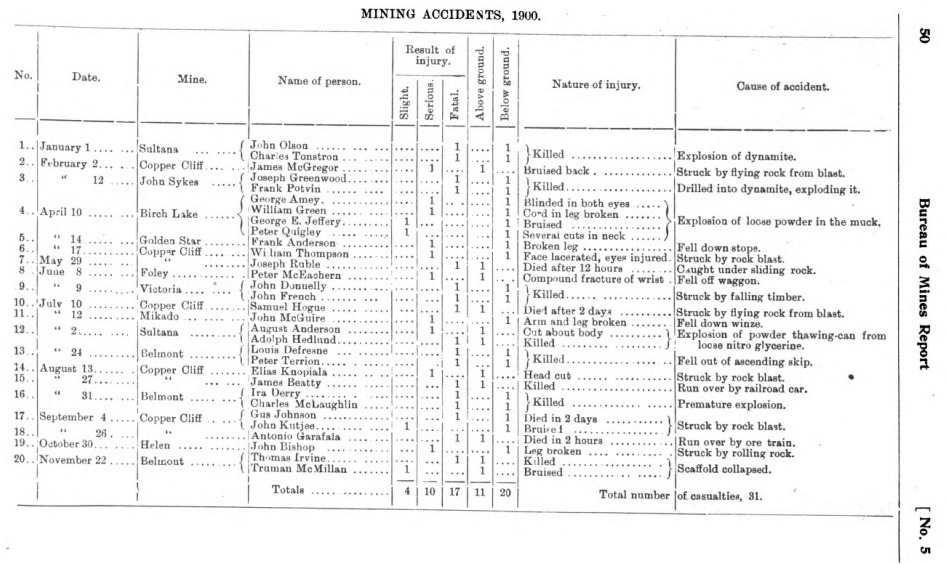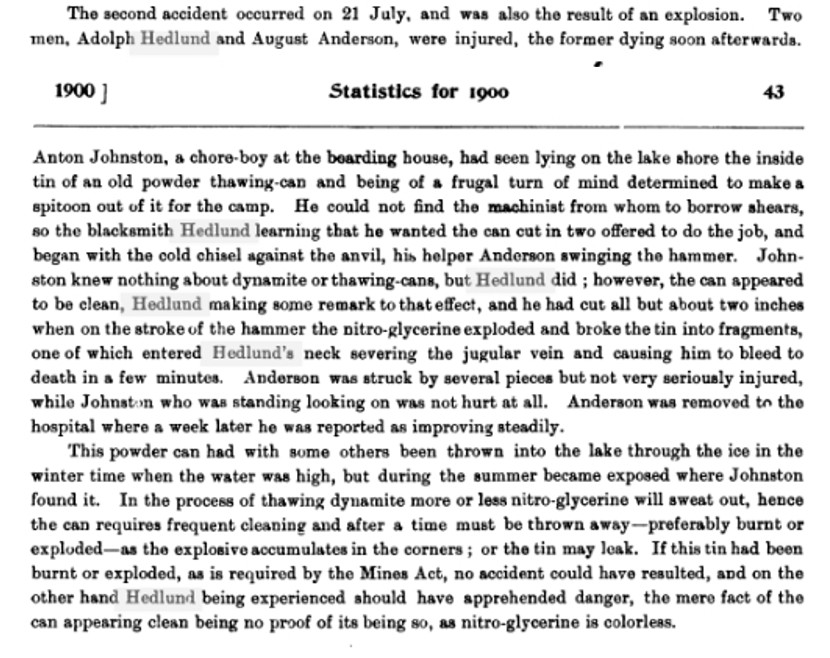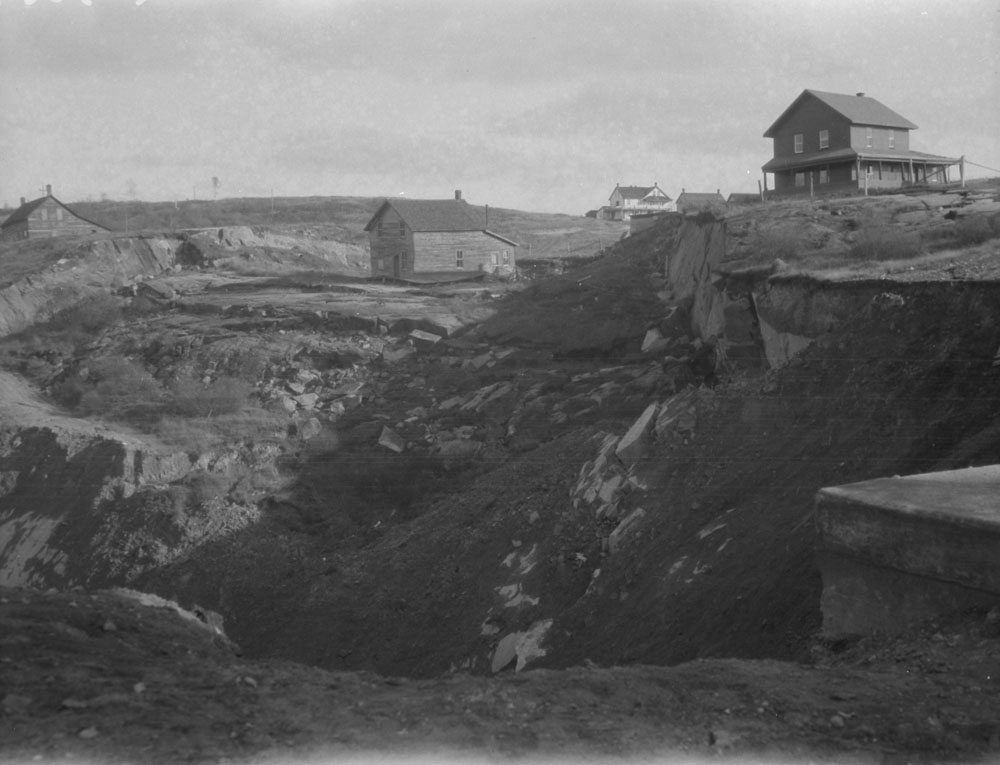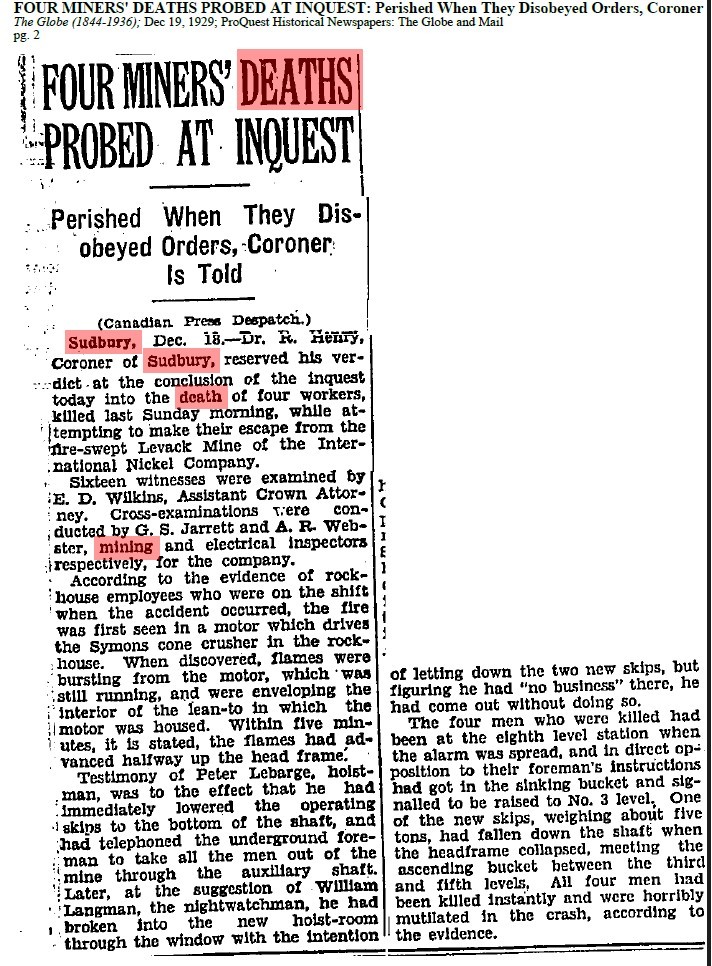
For those of you researching ancestors who were involved in mining in Ontario, elsewhere in Canada and in the UK, resources are available to find information on accidents and fatalities.
The Ontario Ministry of Northern Development and Mines (originally called the Ontario Bureau of Mines) lists annual reports. These start with the first report in 1891 and go to 1970. A sample is as follows:
- ARV01 – First report of the Ontario Bureau of Mines, part 1, 1891
- ARV10 – Tenth report of the Ontario Bureau of Mines, part 1, 1901
British Columbia Minister of Mines Annual Reports
UK Coalmining Accidents, Deaths and Disasters is a database of over 164,000 records containing the details of coal mining accidents and deaths in the UK. Some names are shown as “Withheld” – this is for reasons of Data Protection and relates to all records of people injured since 1950. UK mining disasters, during which 5 or more miners died, are identified from 1600 to date.
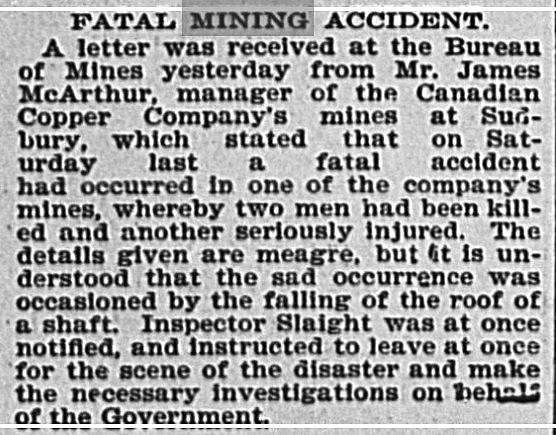
From the Fifth Report of the Ontario Bureau of Mines 1895
GENERAL CITY NEWS: Sep 20, 1894; ProQuest Historical Newspapers: The Globe and Mail
Early reports of injury and death were quite detailed and graphic in their descriptions.
“Under date of August 7th 1895 the Canadian Copper Company reported that at 3 p.m. of that day an explosion of molten slag had occurred at their smelter whereby two of their workmen, James Dubroy and Charles Reinens, were burned about the back and arms. The burns were small, but numerous. The explosion took place in the settling pot at front of No. 1 furnace. Its cause was not quite clear, but it was probably due to the unexpected starting of a rivet head in the settling pot, thus allowing a sudden leakage of water to occur. The men recovered from the accident without having received any permanent injuries.
On 13th August, at the Copper Cliff mine of the same company, one of the workmen named Orson Crank received a compound fracture of the ankle bones of the left leg. The ore was being dumped from the skip to the rock house floor as usual, but a piece rolled on Crank’s ankle before he got out of the way. The injury was severe enough to require amputation of the foot, but otherwise the Company reported on 22nd August that he “was doing very nicely.” At 2 p.m. on August 15th a premature explosion took place on a roasted ore heap at the Copper Cliff mine, by which one Paul Rioux received somewhat severe injuries on the face, eyes, neck and hands. Rioux was in the employ of Messrs. Trist & McKinnon, contractors for roasting the ore, and was the workman whose special duty it was to do the blasting in the ore heaps, having been employed at this work for a long time. The man’s own statement as to the occurrence was as follows: “I lighted the fuse before placing the cartridge in the hole. I then found that the hole was too small, and I tried to push the cartridge in. The fuse burned down quicker than I expected it would, and the cartridge exploded before I got away.” Rioux was taken to the hospital at Sudbury, and although it was at first feared that he would lose the sight of one of his eyes, he made a favorable recovery.”