The Good Friday Flood
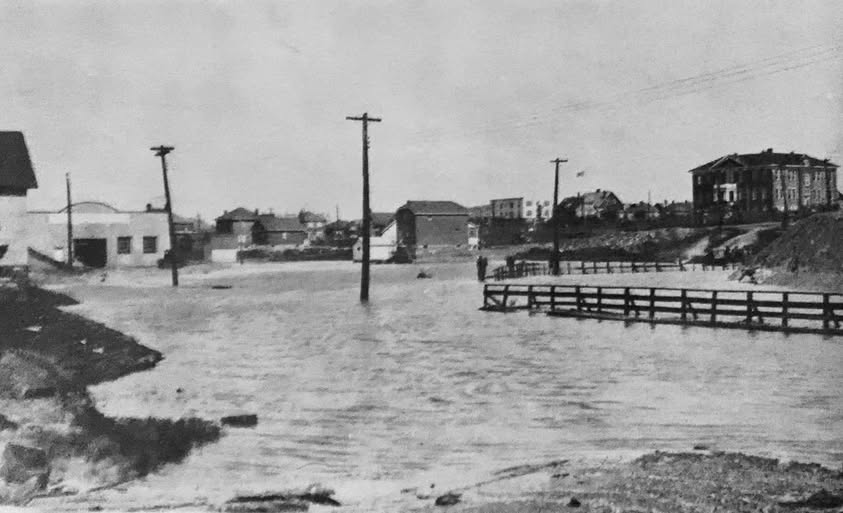
“Nolin and Junction creeks raised from their winter slumber as trickling streams to that of a raging torrent Thursday night and Friday. Although the waters have somewhat receded the flood has by no means subsided yet.
A small sized flood is an annual event with the property owners abutting both creeks, but the amount of water that poured forth yesterday is out of all proportions in the memory of the oldest residents.
The heavy rain of Thursday caused the water to raise with great rapidity and about five o’clock Friday morning the usual limit which a Spring flood attains had been reached. From that until late yesterday afternoon, the water kept rising and invaded living quarters, cellars, barns, wood piles and all in its path.
The greatest destruction was wrought along the course of Nolin Creek where many properties are built on low land and some on the natural bed of the creek. The greater part of yesterday the bridges at Jubilee Hall and the Queen’s Hotel were completely inundated, while the dwellings opposite the Queen’s were surrounded by water and the residents beat an early and hasty retreat, either to the second story or vacated the property completely.

Rescuers navigated the cellar of the Queen’s Hotel in a canoe saving considerable stuff from destruction. Two carloads of slabs, however, glided gently from the yard of the hotel and sailed down stream to Young Street bridge where a boom had been strung.
This about depicts the plight of the majority of residents in the section. Mr. Meyer Silverman had over half a hundred cords of stove wood float out of his yard to the above-mentioned boom, and is probably the heaviest loser in this respect.
W. A. Tait, Wm. Munns and Daniel McNaughton, together with other horsemen swam their horses out. A considerable amount will be lost by all horsemen in the section through the destruction of feed.
On Larch Street, Mr. D. L. Brown had a strenuous time saving two carloads of cement from the rapidly rising waters. He had to shift it four times before he landed it in safe quarters. At this point the water was over four feet higher than Mr. Brown had ever encountered it before.
Six bridges suffered more or less. Two of these, one leading to H. Johns’ farm and one at Larch Street are completely wiped out. The Primeauville Bridge and the Young Street Bridge, superstructures are lifted off their abutments. In the case of the Primeauville Bridge it may require a new structure altogether. Repairing Young Street Bridge it is thought will not incur much expense.
The bridges at Jubilee Hall and the Queen’s Hotel while completely inundated and in the path of the swift current, are not thought to be damaged. The Larch Street bridge has been condemned for vehicle traffic for a year or more and no regrets are expressed that its destruction is now complete. The bridge to the Johns’ farm is private property.
The losses, private and civic, may total several thousand dollars. A correct estimate is a very difficult matter at the present time, as the waters have not sufficiently receded. Superficial estimates, however, are large enough and if the worst fears are realized many property owners will be heavy losers.
Primarily, of course, the abnormal amount of snow during the past winter, the late and slow spring holding back the thaw, together with a very heavy fall of warm rain during Thursday night, is the cause. The outlet, on the other hand, was directly the cause for the backing up of both streams.
The results will no doubt provide plenty of food for though; in civic circles.” The Sudbury Star April 15, 1911
Fires
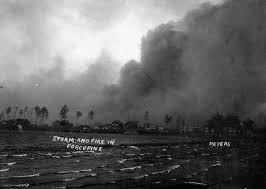
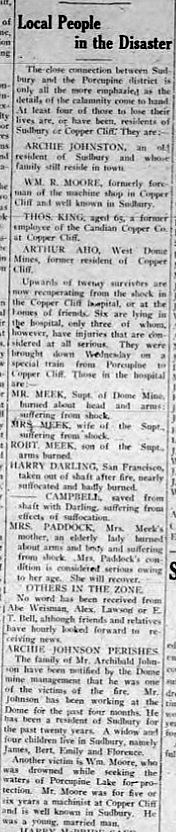
In 1911 fires ranged in Hanmer Township and as far north as the Porcupine Dome Mines. Many victims were treated for burns in the Copper Cliff hospital and in Sudbury homes.
Storms
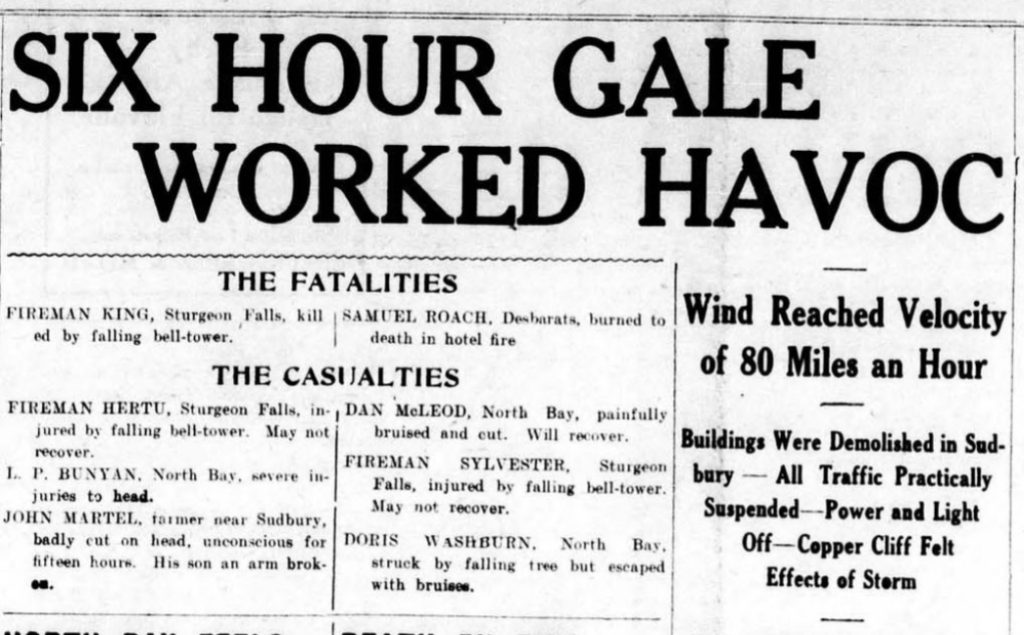
On March 21, 1913 a terrific storm raged through the district, demolishing the CNR concrete roundhouse, braking glass windows in town, toppling trees and unroofing houses.
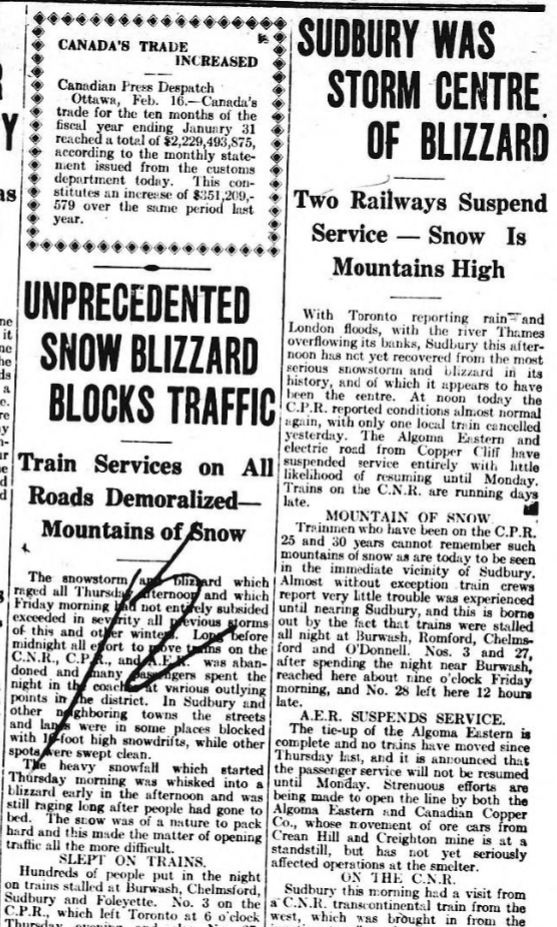
On February 14, 1918 a blizzard disrupted industry for three days.
A three-hour rain storm of deluge proportions, unprecedented in local history, was followed by a 99 degree heat wave on June 28, 1921.
In May 1925 Sudbury was shaken by a mild earthquake.
An electrical storm in the spring of 1931 cracked glass, damaged transformers, toppled trees and billboards.
Friday December 29, 1934 was the coldest ever recorded unofficially in the district 64 below zero.
Creeks overflowed after heavy rains in 1937 and 1938. There was one drowning.